Consider Again Perrins Data on the Number of Mastic Particles as a Function of Height

Combined Peridynamics and Detached Multiphysics to Report the Effects of Air Voids and Freeze-Thaw on the Mechanical Backdrop of Asphalt
ane
Department of Civil Engineering, University of Nottingham, Nottingham NG7 2RD, UK
2
School of Chemic Engineering science, University of Birmingham, Birmingham B15 2TT, Britain
*
Authors to whom correspondence should be addressed.
Academic Editors: Gilda Ferrotti and Francesco Canestrari
Received: 28 December 2020 / Revised: 3 March 2021 / Accepted: 16 March 2021 / Published: 24 March 2021
Abstract
This newspaper demonstrates the use of peridynamics and discrete multiphysics to appraise micro crack germination and propagation in asphalt at low temperatures and under freezing conditions. Three scenarios are investigated: (a) asphalt without air voids under compressive load, (b) cobblestone with air voids and (c) voids filled with freezing water. The first two are computed with Peridynamics, the 3rd with peridynamics combined with discrete multiphysics. The results prove that the presence of voids changes the manner cracks propagate in the material. In asphalt without voids, cracks tend to propagate at the interface between the mastic and the amass. In the presence of voids, they 'spring' from one void to the closest void. Water expansion is modelled by coupling Peridynamics with repulsive forces in the context of Discrete Multiphysics. Freezing water expands confronting the voids' internal surface, building tension in the material. A network of cracks forms in the asphalt, weakening its mechanical backdrop. The proposed methodology provides a computational tool for generating samples of 'digital asphalt' that can be tested to assess the asphalt properties under different operating conditions.
one. Introduction
Asphalt, a heterogeneous mixture of aggregates, fillers and asphalt binder, is one of the most used infrastructure textile. Asphalt's mechanical backdrop are influenced by the properties of its constituents, its internal construction and the loading and ecology conditions during its service life. Agreement the degradation of cobblestone, such as rutting, ravelling, freezing, force loss and fatigue cracking, is important for ameliorate blueprint, manufacture and maintenance of roads.
One of the major sources of deterioration of cobblestone is cracking. The fracture procedure can be divided into two different stages [1,two]: crack initiation and propagation. Cleft initiation occurs when the mechanical stress is college than a given limit, and micro-cracks occur in the mastic [three]. Under continuous load, these micro-cracks coalesce into macro-cracks, which initiate the propagation stage that ultimately, leads to failure [1]. The growth of microcracks damages asphalt irreversibly and increases maintenance costs [4], and this is influenced by unlike factors such as temperature, loading level and rate, fatigue and mixture composition.
Some other cause of cobblestone failure in cold regions is thermal nifty (at low temperatures), which may significantly reduce the durability of pavements [5,six]. This damage is especially severe when water is present in the cobblestone pores due to its comparatively high thermal expansion. Under icing temperatures, the internal pore construction in an asphalt mixture may change post-obit a three-stage process [7]: (i) water expansion, which causes impairment, and expansion of the exiting pores; at −10 °C, for instance, water undergoes 15% volume expansion [viii]; (ii) cracking and merging of the pores and (iii) creation of new voids [9]. This phenomenon is especially intense in asphalts with a porosity between half dozen% and thirteen%, which retain part of the pore water. Asphalts with <six% voids have close pores that foreclose water penetration, while asphalts with >thirteen% voids have large pores that do not retain water [10,eleven,12].
At that place are many studies, both theoretical and experimental, on cobblestone deposition (e.one thousand., [three,4,xiii,14,15,16]), merely only a few experimental works dedicated to low temperatures and freeze-thawcycles [5,six,7,17,eighteen,19]. Furthermore, the experimental tests cannot evidence the evolution of the harm inside the asphalt's microstructure, which is critical for understanding the deterioration mechanisms. To the all-time of our knowledge, in that location are also no bachelor numerical methods for predicting degradation of asphalt or monitoring the damage progression resulting from freeze-thawactions. The development of such modelling tools, the subject of this newspaper, allows estimation of cobblestone'southward service life performance under cold environmental conditions. This is disquisitional for optimising asphalt or developing novel materials with enhanced durability and long-term performance.
Contempo advancements in reckoner technology let performing realistic simulations of the operation of materials across scales. Novel mesh-free methods are more suited for this purpose as they permit simulation of crack propagation and branching without the need for mesh regeneration. One of the simplest mesh-free methods is the lattice spring model (LSM) that divides solids into computational particles linked together with springs [xx,21,22]. Peridynamics (PD) [23] is a novel mesh-free method developed as an improvement of the LSM [24] to allow meliorate simulation of the material damage response. The awarding of PD to the simulation of damage in construction materials is highly innovative and limited, and its asphalt application volition be presented in this paper for the first time.
This newspaper aims to develop a computational tool that allows realistic simulation of the damage of asphalt nether mechanical and freeze-thawloads. We nowadays a PD model coupled with detached multiphysics developed in the LAMMPS molecular dynamics simulation parcel. This requires developing realistic models because the aggregates and binder, voids and water, both in liquid and solid forms. Optical and micro-CT images are used to develop models considering the internal microstructure of a range of asphalt materials. PD implemented in LAMMPS also allows considering the plastic [25] and viscoelastic [26] response of materials and is therefore suitable for simulation of the response of asphalt materials under college temperatures. The state-based Peridynamics is used here to evaluate the mechanical response of intact asphalt before and after being subjected to a freeze-thawcycle. The internal damage in the asphalt due to freezing is simulated by coupling Peridynamics with repulsive forces obtained from expansion of liquid phases and their transformation into solid phase using Discrete Multiphysics (DMP) [27,28,29]. The model is and then used to discuss the result of the freezing of the water present in the voids on the asphalt's mechanical response.
2. Theory
ii.1. Peridynamics
In Peridynamics, the cloth's torso is defined as a lattice, and contrary to classical continuum mechanics, its behaviour is defined through a constitutive equation that links deformation and force rather than strain and stress. The original bond-based Peridynamic approach [23] was limited to materials with a Poisson ratio ¼ in 3D and ⅓ in 2D. State-based Peridynamics [thirty] was introduced to overcome these limitations. In land-based Peridynamics, the forces that connect two bonded elements depend on the overall state of all the particles located within a fabric horizon rather than the single bond. The acceleration of whatever particle at position x in the reference configuration at time t is found from:
where ρ(x) is the mass density at x, u is the displacement vector field, Hx is a neighborhood of
with radius
containing all the points
inside the horizon,
is the pairwise force state function at time t whose value is the forcefulness vector (per unit volume squared) acting betwixt two particles within the horizon applied to the bail
,
is the infinitesimal volume, b is a body force density field. The relative position vector state of these two particles in the reference configuration ε is given past
where X represents the reference land, mapping all bonds in a not-plain-featured body, B0. The relative displacement vector state U is associated with the bond by:
The deformation state Y expressed in Equation (4) maps all bonds into its deformed image, B, Effigy i.
Material behaviour is modelled by leap-similar bonds between particles x and 10' inside the horizon. The force interim on particles x and x' is:
where f is the scalar office of the force country named the forcefulness modulus state.
The strength scalar country is given past [25,31]:
where ω is a scalar weighting office chosen the influence function whose argument is the bond vector ε in the reference configuration [31], east is the extension scalar state divers as
, ten is the reference position scalar state defined as
, m is the weighted volume defined as m = (ωx)∙ten, θ is the scalar land book dilatation of the neighbourhood H defined as
, eastd is the scalar deviator state component of the bail elongation defined as
, K is the majority modulus and α is related to the shear modulus M every bit:
To model fracture, we introduce the notion of bail failure in relation to the bail's stretch south divers by:
The breakage rule is that when south is larger than a disquisitional value south0, the bond breaks and is removed from the trunk. The critical value s0 is defined as [32]:
where G 0 is the fracture energy. The value of s 0 is not constant, but varies during the simulations based on its damage divers as:
where μ is a history dependent impairment function that takes on a value of 0 or 1, i.e.,:
For materials such as mastic, south0 depends on smin, the current minimum stretch among all bonds continued to a given material point [thirty]:
where south00 is a constant and:
2.two. Modelling of Ice
To model ice, nosotros take advantage of the flexibility of particle methods that can hands combine with other particle-based potentials in the context of discrete multiphysics. In this way, it is possible to extend the range of application of a single method past introducing potentials typical of other particle methods. This technique has been successfully used in several fields including fluid–construction interactions [33,34,35], solidification/dissolution [36,37], biological flows [38,39,40] and even auto learning [41,42]. In the case nether investigation, we do non model h2o as a fluid. We are only interested in the pressure level that expanding (i.eastward., freezing) h2o exerts on the cobblestone structure. This can be achieved past a repulsion potential betwixt water-water and h2o-asphalt particles. We use the positive (i.eastward., repulsive) branch of the Lennard Jones potential:
where r is the distance between 2 particles,
is an energy abiding that determines the particle's rigidity and
is the distance at which the inter-particle potential is nada. The condition r < 2⅙
assures that only the repulsive part of the potential is used. Equation (14) comes from molecular dynamics, but here it provides a repulsive potential that avoids compenetration of h2o particles with mastic and aggregate particles (and amongst themselves) for distances smaller than
. The value of εLJ for ice can be approximated as follows (for simplicity, in the following discussion, we will name εLJ and σLJ simply every bit ε and σ). We assume that under the hypothesis of small deformations r ≈ r 0, the Lennard Jones potential approximates the Harmonic potential; see Figure 2. From the potentials in Equation (15), the forces are derived in Equation (16), Table 1.
Assuming that repulsive force betwixt particles can exist modelled equally linear springs, the leap constant thousand is a part of the depth of the potential:
According to Kot et al. [43], the bulk modulus for a regular cubic lattice is:
and, therefore,
where
is an energy constant, K is the bulk modulus and r 0 is the lattice constant at which the potential is zero (i.eastward., r 0 = l, the initial distance betwixt h2o particles). Expansion is simulated by increasing the parameter σ LJ . During the simulation, σ LJ goes from σ 0 LJ = l [m] at t = 0 to σ END LJ = 1.05fifty, corresponding to a xv% volume expansion of water at the stop of the simulation.
3. Methodology
The real and bogus asphalt mixtures used in this report are presented and discussed in this section. Both imaging of the section and micro-CT browse results are used to generate the initial microstructure of the asphalt models to evaluate the accuracy of the techniques used. The digital microstructures are so modified to represent a range of void % and saturation degree in the cobblestone microstructure. The details of the processes followed are besides presented in this section.
The numerical models, afterward validation, were used to simulate compressive tests on asphalt before and after being subjected to a bike of freeze-thaw. The damage progression under compressive loading and the freeze-thaw was evaluated and discussed with the aim of the numerical results obtained. The details of the numerical analyses and the input parameters used are also presented in this section.
3.1. Mixtures
The asphalt models used in the simulations were derived from samples of four types of asphalts: Dense Asphalt (DA), Porous Asphalt #1 (PA #1), Porous Asphalt #2 (PA #2) and Porous Asphalt #3 (PA #iii), with target air voids of 5 x, 13 and 21%, respectively. The physical samples were prepared in the NTEC laboratories at the University of Nottingham, Nottingham, UK. CT-scanned and (as explained later) digitalised in a format readable by the software used to behave out the simulations.
The composition, amass gradation and folder contents in the samples are shown in Table 2. For all mixtures, crushed limestone aggregates with a maximum size of twenty mm and fifty/lxx pen bitumen were used. The standards BS EN 13043:2013 for DA, BS EN 13108-1 for PA and BS EN 12697–33 were followed to manufacture the materials [44]. The materials were mixed at 160 °C and roller compacted at 140 °C. Asphalt slabs of 300 × 300 × 50 mm3 were produced. From the DA slab, a 35 × 35 × 55 mm3 was cut. From the slabs fabricated of PA #ane, PA #ii and PA #3, cores of 100 mm diameter and 50 mm height were extracted.
3.2. DA Model
The DA sample surface was photographed using a digital camera with resolution 1257 × 896 and the pictures converted in a black and white image with MATLAB R2020a (The Math Works, Inc., Natick, MA, USA) and over imposed on a square lattice with side l = ten−4 m. Each node of the lattice corresponds to a Peridynamic particle: blue particles were created to represent mastic and red particles to represent aggregates, come across Effigy iii. According to the reference [45], aggregates greater than i.eighteen mm can be considered office of the solid skeleton structure. Hence, mastic was defined every bit a mixture of aggregates ≤ 1.18 mm and bitumen. While we are aware that this is a simplification, nosotros volition assume that this value remains constant for the mixtures that nosotros studied.
In DA, voids were not considered due to the difficulty of identifying them using digital photography. DA has 190,000 particles for the mastic and 300,000 for the aggregates.
3.three. PA Models
A Phoenix v|tome|x 50 300 micro CT scanner was used to scan PA asphalt samples under dry conditions; the X-ray tube was MXR320HP/11 (3.0 mm Be + two mm Al) from GE Sensing and Inspection Technology (Shanghai, China) operating with an dispatch voltage of 290 kV and a current of 1300 mA.
We carried out the Ten-ray CT scans in the micro-computed tomography Hounsfield facility at the University of Nottingham, Nottingham, U.k.. Nosotros mounted the samples on a rotational tabular array at a distance of 906.84 mm from the X-ray source. The reconstruction of scans was performed using GE Datos|x reconstruction software with 2× resolution to obtain a spatial resolution of 45.ii mm; the scans had an isotropic resolution, meaning that the slice thickness was too 45.2 mm. The raw images were 16-chip images, and the voxel value represented the 10-ray attenuation.
Then, ImageJ version 1.49 was used to process the images [46], convert them to eight-bit grayscale resolution and denoise the images to remove minor clusters of voids and grains. The different material components such every bit aggregates, bitumen and air voids were extracted by segmenting the images based on grayscale thresholding using ImageJ version ane.49 (Rasband, W.Due south., ImageJ, U. Due south. National Institutes of Wellness, Bethesda, MD, United states).
The pic was over imposed on a square lattice with side l = 4 × 10⁻⁴ thousand using Matlab 2020a. As in the case of DA, each node of the lattice corresponds to a peridynamic particle: bluish particles are assigned to mastic, and red particles are used to stand for aggregates, encounter Figure iii. No computational particle was created in areas corresponding to the voids. Since the void fraction and aggregate size differed in the 3 samples, the number of particles was not the aforementioned. Sample PA #1 had 341,000 particles for the mortar and 367,000 for the aggregates; PA #2 148,000 particles for the mortar and 538,500 for the aggregates; PA #iii 172,000 particles for the mortar and 455,000 particles for the aggregates.
3.four. Additional Asphalt Geometries
To generate new geometries of asphalt mixtures with a range of air void properties, using ImageJ, we assumed that the mixtures from Figure 4 were the reference. From each of these specimens, we produced v dissimilar materials. (i) Without air voids; (ii) with the 25% smallest air voids; (3) with the fifty% smallest air voids; (iv) with 75% of the smallest air voids and (v) with 100% of the air voids (equivalent to the reference sample). See an instance in Effigy five. The air voids' geometries, including the average void expanse, diameter, perimeter, circularity and attribute ratio, were measured using the Particle Assay office in ImageJ [45]. Finally, a suffix indicating the final void fraction was assigned to each generated sample. For example, PA #i/2.5% means that nosotros started from PA #1 and filled all the voids so that the final void fraction was ii.5%. The amass gradation and folder contents are shown in Table 3. Increasing the amount of mastic, we add bitumen and dust smaller than 1.18 mm, keeping the skeleton structure constant.
Table 4 shows the topological properties of air voids in asphalt mixtures produced in this section. Similar results were presented in [12]. These results will be used beneath to evaluate the influence of freezing on the deposition of pavements.
3.5. Freeze-Thaw Simulation
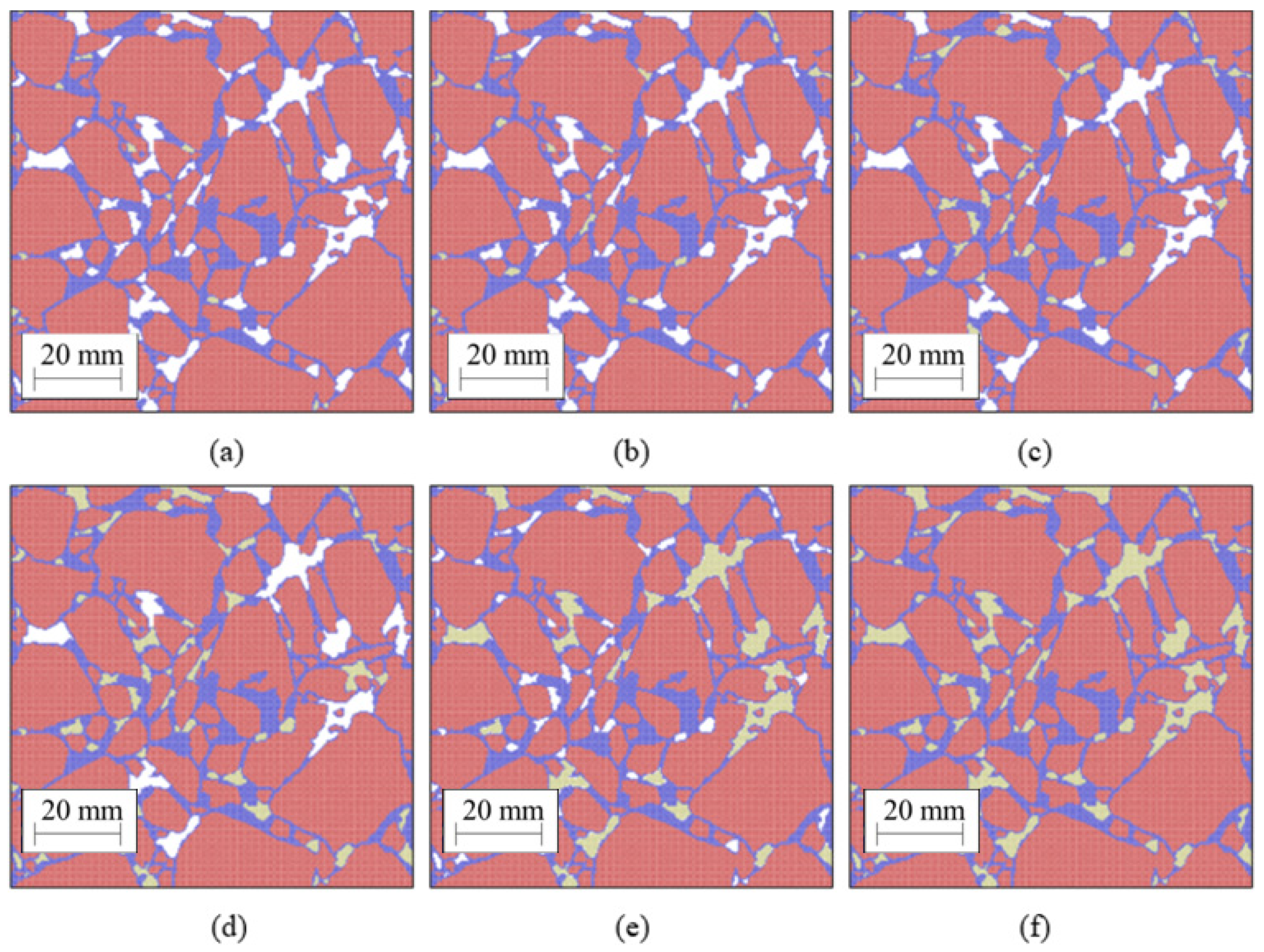
We only used PA #two, which has a 13% air void content, to evaluate the consequence of freeze-thaw on mechanical properties. For this purpose, nosotros artificially filled some of the voids with ice, presented as yellow particles in Figure six. To distinguish among samples, a suffix indicating the final ice content was assigned to each generated sample. For example, PA #2/0.65% means that we started from PA #2 and filled all the voids so that the final water ice content was 0.65%. Figure 6 shows how this process was carried out. Nosotros started with the real PA #2 sample whose void fraction was xiii%. And so, we gradually covered some of the voids (chosen randomly) with ice (yellowish particles) until the ice content was 0.65%, Effigy 6a, i.3%, Figure 6b, 3.25%, Effigy 6c, 6.5%, Effigy 6d, 9.75%, Figure 6e and finally xiii%, Figure 6f. The freeze-thaw simulation was performed following these steps:
-
Water expands in the voids simulating ice formation, leading to cracking.
-
Later on the water expansion is completed, the simulation is carried out for additional 106 time steps to relax the system with no external load.
-
Water shrinks in the void, simulating ice melting.
-
H2o is removed.
-
Later the water is removed, the simulation is carried out for additional 10vi time steps to relax the arrangement with no external load.
-
Finally, the sample is tested under imitation compression to assess mechanical response changes afterwards the sample is subjected to a freeze-thawcycle.
three.half-dozen. Numerical Modelling Details and Input Parameters
The intrinsic backdrop of the mastic and aggregate were the aforementioned for all simulations. In this written report, we focused on temperatures below −10 °C and, therefore, nosotros used the Peridynamic model for brittle materials discussed before. The mechanical properties used in the simulations of bitumen and asphalt mixtures are reported in Table 5; they were obtained from [47] and [48]. The peridynamic parameters of the asphalt binder used for the simulations are listed in Table half-dozen.
The adding of the temperature profile inside the sample would require a non-isothermal model (the reader can refer to [37] for modelling heat transfer and phase transition with particle methods). During solidification, water remains at 0 °C because of the latent oestrus. The scenario we have in mind is when the water has permeated into the cobblestone and freezes. We assume that the external temperature is sufficiently depression; as a first approximation, the average temperature of the asphalt sample is close to −ten °C.
To simulate a uniaxial compressive test, each sample is placed into the simulation box betwixt ii rigid walls (boundary weather condition). The simulations are carried out nether plane stress weather condition. For the model, this implies that nosotros take a parallel slice with a thickness larger than the horizon and impose the stress along the z direction equal to zero. The concrete parameters at the interface were prepare to the physical parameters of the mastic. The upper wall moves downward at a controlled velocity, and the lower wall is stock-still. Uniaxial compression exam simulation is carried out forth the y-direction at a pinch charge per unit of 0.001 m/s; (we verified that quasi-static conditions were accomplished at 0.001 k/s), the other directions were fix to be gratis to expand or shrink. The time step used in all simulations was 10−8 s.
The Peridynamic stress was calculated from the total force per volume, interim through the showtime layer of particles in contact with the upper wall. The resultant force was obtained past multiplying the particle's volume and the average force density of the top layer. The simulations were carried out with the Peridynamics package [49] in LAMMPS/stable_7Aug2019-foss-2019a (http://lammps.sandia.gov) [50].
four. Model Validation
We modelled the tensile strength of bitumen beams tested in [45] to validate the accuracy of the modelling strategy and its parameters. For this purpose, we produced 3D and thin plate (i.e., pseudo 2D with the thickness slightly larger than the horizon imitation under the airplane stress condition) models of the bitumen with different resolutions (number of particles used for development of the model) and checked the sensitivity of the results to these parameters.
The 3D specimen had dimensions of 1.0 × five.0 × 0.5 cm3 false with 4 lattice resolutions in the range l = ten−3 – x−4 m; see Figure 7a–c. In addition, the thin plate specimen had dimensions of one.0 × 5.0 cm2 and a resolution of 50 = ten−three – 10−4 m, run into Figure 7d.
The number of particles in the 3D samples was 3366, 23,331, 332,826 and 2,580,641, for l 10−3, 5 × 10⁻⁴, ii × x−4 and 10−4 m, respectively. The number of particles in the thin plates was 3927, 14,847, 76,806 and 303,606, for l 10−three, 5 × 10⁻⁴, ii × x−4 and ten−4 thou, respectively. The simulations were conducted at the two strain rates, xxx and 140 mm × min−ane. The Peridynamic stress was calculated from the total force per book, acting through the start layer of particles in contact with the upper wall.
Figure eight shows the bitumen'due south beam's failure in a 3D simulation showing that breakage is visually comparable with an equivalent experiment from the literature [45].
Figure 9a shows the tensile results of the 3D beam. Results are contained of the loading rate, and when the particle resolution is l < 2 × 10−iv m, simulations are very close to the experimental information. Figure 9b shows the 2nd (thin plate) results. For fifty < ii × x−four m, the results are independent of the particle resolution. Withal, opposite to the 3D results, they do not converge to the experimental data. In 2nd, the greatest difference between the experiment and simulation is 10%. Even so, the 3D simulation at fifty = x−4 m has eight times as many particles as the second simulation at the aforementioned resolution, which makes the simulation 16 times slower. Therefore, nosotros decided to accept the error and run the simulations for thin plates at lattice l = 10−4 m.
v. Results and Give-and-take
v.1. Compressive Response of DA Asphalt
The issue for the uniaxial compression examination for each sample is shown Figure 10a. The stress-strain curve follows an equivalent trend to that of experimental curves reported in the literature for asphalt at depression temperatures showing brittle behaviour [51]. As expected, the stress increases with the pinch, undergoing a sudden fracture and leading to total failure of the samples.
The stress-strain bend and the percentage of broken Peridynamic bonds (harm) in the sample are compared in Figure 10a to illustrate the relationship betwixt stress and impairment. Two stages from the stress-strain bend can be distinguished during the failure process [52]. In Phase I (strain < 0.015%), there are no obvious cracks. Stage 2 occurs when the local strain reaches the disquisitional value s0. Some of the bonds begin to break, generating micro-cracks in the aggregate. As the strain increases further, micro-cracks propagate, weakening the cloth, and the load exceeds the ultimate forcefulness of the sample; micro-cracks evolve around the aggregates, resulting in large deformations and ultimately the devastation of the sample. Finally, Effigy 10b shows that micro-cracks form mainly in the aggregate, peculiarly at the interfaces, which tin can be considered the asphalt'south weak part.
5.2. Compressive Response of PA Asphalt
Uniaxial compression tests of the PA test specimens mentioned to a higher place were besides simulated to determine whether the peridynamics could capture the air voids' influence on the asphalt's compression strength. All the samples were subjected to the aforementioned load and boundary conditions every bit the DA samples. Figure 10 compares stress/strain curves for PA #i, PA #2 and PA #3, in the range of the air void contents studied.
According to Effigy xi, the cobblestone stiffness and the height load decrease by increasing the number of voids and their size. The maximal stress decreased past 64% (PA #one), 77% (PA #2) and 91% (PA #3) compared to the same cobblestone with no voids, and the weakening of the fabric led to early breakage. In real cobblestone, this could hateful that the weakening of the material due to air voids' presence leads to early breakage [2,30]. Hence, to produce durable asphalt, especially at lower temperatures, when the asphalt is prone to ravelling, it is advised that the content of mastic in the material is maximised.
There are different types of asphalts that cover a wide range of compressive strengths depending on the bitumen, aggregate, fillers and voids. Our asphalt is in line with the compressive results for asphalts reported in the literature e.g. [53,54,55] at the same temperature. According to the sample and the void fraction, the model'due south values in Effigy 10 are between 0.5 and 3.5 MPa. Reference [53] reports values between 1.5 and ane.9 MPa, reference [54] betwixt 2 and 3 MPa and [55] betwixt ane.7 and 2.two MPa, which are in the same range as our simulations. The model's compressive results depend on the choice of parameters, and specifically G0, the fracture energy reported in Table five, used in the simulations. G0 was taken from [48] and refers to weakly aggregated dolomite limestone [48], unremarkably used to build route bases or binder courses. Hence, the compressive strength of asphalt will reflect the poor properties of these aggregates. Properties of additional aggregates can exist institute in reference [56].
Table 7 reports the Pearson's correlation between the mechanical and the topological properties of the samples. The max stress and the max deformations are, respectively, the maximal stress and deformation before the sample's failure, while for the equivalent Young's Modulus, the slope of the linear part of the stress/strain bend, see Effigy 11.
As expected, a college void content reduces the uniaxial compressive forcefulness of the asphalt. Table 7 besides shows that larger voids are more detrimental than smaller voids for the aforementioned void content. Moreover, given the same void size, samples with elongated and irregular shapes (i.e., high aspect ratio, low circularity) evidence, in full general, lower ultimate strength and an equivalent Young's modulus than samples with circular-like voids. The reasons for this are still unclear and volition be investigated in future research.
To compare changes of forcefulness betwixt the different types of asphalt analysed due to changes in gradation and amount of mastic, we have defined the parameter
equally:
Finally, Effigy 12 shows how β varies with the air voids fraction for PA #ane, PA #2 and PA #3. It can be observed that small changes in the void fraction take a lower influence on the compressive force of cobblestone for densely packed mixtures. Still, other types of mixtures, such as PA #3, could exist extremely sensitive to changes in the corporeality of voids, for instance, due to the lack of filler or changes in the source of dust, and farthermost care should be taken during their design and manufacturing. This will be a point that we volition analyse experimentally in future research.
5.3. Event of Freeze-Thawon the Compressive Strength
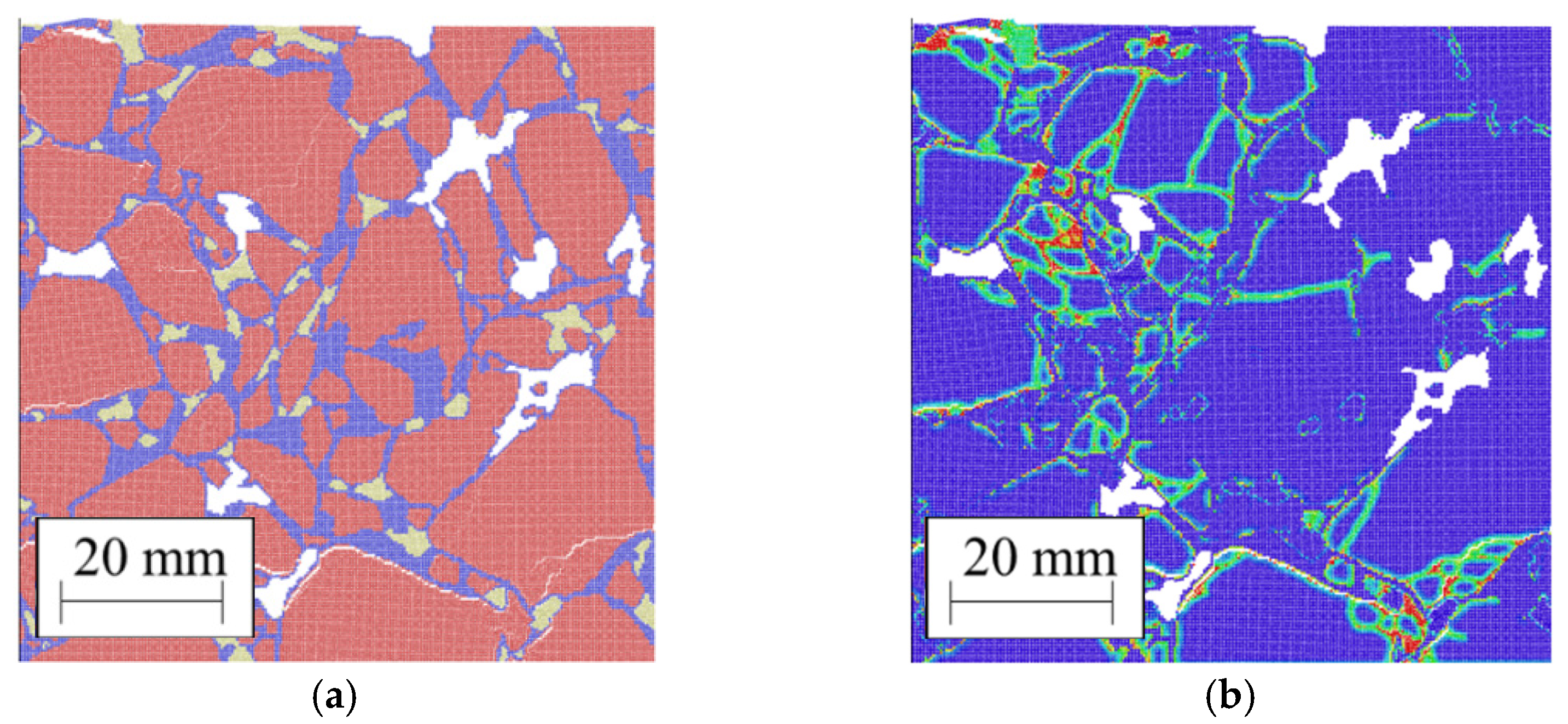
Figure xiii shows the sample during the water ice expansions. Breakage starts where ice expands and propagates at the bitumen-aggregate interface. This also creates new voids and increases the void fraction [7]. As expected, the freeze-thawcycle decreases the force of asphalt [57,58,59]. To quantify this decrease and compare the simulations with experimental data, we ascertain the reduction of the tiptop stress after freeze-thawas follows:
Figure 14 shows how γ varies with the ice fraction and confirms the ice's impact on fracture functioning. During the water ice expansion, cracks appear in the structure, and the stiffness of asphalt is compromised, leading to a reduction in the sample'southward peak stress and earlier failure.
These results compare with experimental data. For example, reference [9] has determined that for a porous cobblestone mixture with approximately 20% air void content, the strength loss can be higher than forty%. Further, near of the strength is lost subsequently the first bicycle, as shown in Effigy xiii. In hereafter research, this computational framework volition be used to better understand the influence of air voids' geometrical properties on the resistance of the asphalt to freeze-thawcycles.
6. Conclusions
In this article, we take demonstrated the use of Peridynamics combined with Discrete Multiphysics to model crevice formation and propagation in asphalt at low temperatures taking into account air voids and ice germination. Find below some of the conclusions:
-
This paper demonstrates a way to understand how microcracks are formed in the asphalt nether freezing weather, a phenomenon that is extremely difficult to notice in experiments.
-
The simulations bear witness the model's reliability in obtaining a mechanical response comparable with experimental tension and compression tests of bitumen and cobblestone, respectively.
-
As expected, the higher the void fraction, the higher the loss of compressive strength of an asphalt mixture. Further, the size and shape of the voids touch the strength of the cobblestone. Larger voids are more than detrimental than smaller voids, specially if they have a loftier attribute ratio and low circularity.
-
Using this model, nosotros observed that the amount of mastic in densely packed mixtures does not have a strong influence on the compressive strength of asphalt. However, less densely packed mixtures, such as porous asphalt, are more than sensitive to the amount of mastic in the asphalt.
-
The model can also assess the issue of ice formation on the asphalt structure. Water particles are created in the voids, and their book is increased with time to simulate solidification. The simulations show the germination of cracks produced by water expansion during solidification and the consequent loss in mechanical strength. To the best of our knowledge, water expansion in cavities has not been simulated to date.
This methodological study provides researchers in the field with a powerful new tool for understanding the behaviour of asphalt under scenarios that, so far, accept not been attainable to computer simulation. The systematic written report of cobblestone mechanical properties changes due to the size, number and distribution of ice-filled voids will be washed in future research.
Writer Contributions
Conceptualisation, D.S., B.G., A.A., A.G.H.; methodology, All authors; software, D.S, B.G., A.A.; validation, D.Southward.; formal analysis, D.Southward.; investigation, D.Due south.; resources, All authors; data curation, D.S.; writing—original draft preparation, All authors; writing—review and editing, All authors; visualisation, All authors; supervision, B.G. A.A., A.Chiliad.H. All authors have read and agreed to the published version of the manuscript.
Funding
PhD fund lead to this study was provided by the Faculty of Applied science of the University of Notitngham and the Schoolhouse of Chemical Engineering science of the Academy of Birmingham.
Institutional Review Board Argument
Non applicative.
Informed Consent Statement
Not applicable.
Data Availability Statement
The lawmaking used for the simulations is freely available under the GNU General Public License v3 and can be downloaded from the University of Birmingham repository http://edata.bham.ac.great britain/568/.
Acknowledgments
The authors express their gratitude to the Universities of Nottingham, Birmingham and Highways England UK that funded this study.
Conflicts of Interest
The authors declare no conflict of interest.
References
- Bobiński, J.; Tejchman, J. A coupled constitutive model for fracture in plain physical based on continuum theory with non-local softening and eXtended Finite Element Method. Finite Elements Anal. Des. 2016, 114, 1–21. [Google Scholar] [CrossRef]
- Suchorzewski, J.; Tejchman, J.; Nitka, M. Discrete chemical element method simulations of fracture in concrete under uniaxial compression based on its real internal structure. Int. J. Damage Mech. 2018, 27, 578–607. [Google Scholar] [CrossRef]
- Ling, M.; Zhang, Y.; Kaseer, F.; Martin, A.Due east.; Lytton, R.Fifty. Investigation of fracture behavior of asphalt mixture composite using energy-based approach. Compos. Function B Eng. 2020, 181, 107324. [Google Scholar] [CrossRef]
- Kollmann, J.; Liu, P.; Lu, Thousand.; Wang, D.; Oeser, Chiliad.; Leischner, South. Investigation of the microstructural fracture behaviour of cobblestone mixtures using the finite element method. Constr. Build. Mater. 2019, 227, 117078. [Google Scholar] [CrossRef]
- Ozgan, E.; Serin, Southward. Investigation of sure engineering science characteristics of cobblestone concrete exposed to freeze-thawcycles. Common cold Reg. Sci. Technol. 2013, 85, 131–136. [Google Scholar] [CrossRef]
- Tang, Northward.; Dominicus, C.; Huang, S.; Wu, S. Impairment and corrosion of conductive asphalt concrete subjected to freeze-thawcycles and salt. Mater. Res. Innov. 2013, 17, 240–245. [Google Scholar] [CrossRef]
- Xu, H.; Guo, W.; Tan, Y. Internal construction evolution of asphalt mixtures during freeze-thawcycles. Mater. Des. 2015, 86, 436–446. [Google Scholar] [CrossRef]
- Butkovich, T.R. Thermal Expansion of Ice. J. Appl. Phys. 1959, thirty, 350. [Google Scholar] [CrossRef]
- Sol-Sánchez, One thousand.; Moreno-Navarro, F.; García-Travé, G.; Rubio-Gámez, Thou.C. Laboratory study of the long-term climatic deterioration of asphalt mixtures. Constr. Build. Mater. 2015, 88, 32–xl. [Google Scholar] [CrossRef]
- Xu, H.; Guo, Westward.; Tan, Y. Permeability of asphalt mixtures exposed to freeze-thawcycles. Cold Reg. Sci. Technol. 2016, 123, 99–106. [Google Scholar] [CrossRef]
- Aboufoul, M.; Shokri, North.; Saleh, E.; Constrict, C.; Garcia, A. Dynamics of h2o evaporation from porous asphalt. Constr. Build. Mater. 2019, 202, 406–414. [Google Scholar] [CrossRef]
- Aboufoul, M.; Garcia, A. Factors affecting hydraulic conductivity of cobblestone mixture. Mater. Struct. Mater. Constr. 2017, 50, 116. [Google Scholar] [CrossRef]
- Hernandez-Fernandez, N.; Underwood, B.S.; Ossa-Lopez, A. Simulation of the asphalt physical stiffness degradation using simplified viscoelastic continuum damage model. Int. J. Fatigue 2020, 140, 105850. [Google Scholar] [CrossRef]
- Li, Y.; Jiang, W.; Shan, J.; Li, P.; Lu, R.; Lou, B. Characteristics of void distribution and aggregate deposition of asphalt mixture specimens compacted using field and laboratory methods. Constr. Build. Mater. 2020, 270, 121488. [Google Scholar] [CrossRef]
- Canestrari, F.; Ingrassia, L.P. A review of meridian-downward cracking in asphalt pavements: Causes, models, experimental tools and future challenges. J. Traffic Transp. Eng. Engl. Ed. 2020, 7, 541–572. [Google Scholar] [CrossRef]
- Liu, H.; Zeiada, Due west.; Al-Khateeb, G.Grand.; Shanableh, A.; Samarai, Chiliad. Utilise of the multiple stress pitter-patter recovery (MSCR) test to characterize the rutting potential of asphalt binders: A literature review. Constr. Build. Mater. 2020, 269, 121320. [Google Scholar] [CrossRef]
- Yan, K.; Ge, D.; You, 50.; Wang, 10. Laboratory investigation of the characteristics of SMA mixtures under freeze-thawcycles. Cold Reg. Sci. Technol. 2015, 119, 68–74. [Google Scholar] [CrossRef]
- Fan, Z.; Xu, H.; Xiao, J.; Tan, Y. Effects of freeze-thawcycles on fatigue performance of asphalt mixture and development of fatigue-freeze-thaw(FFT) uniform equation. Constr. Build. Mater. 2020, 242, 118043. [Google Scholar] [CrossRef]
- Cong, 50.; Ren, Grand.; Shi, J.; Yang, F.; Guo, G. Experimental investigation on performance deterioration of asphalt mixture nether freeze-thawcycles. Int. J. Transp. Sci. Technol. 2020, 9, 218–228. [Google Scholar] [CrossRef]
- Zhang, Z.N.; Chen, Y.10. Modeling nonlinear rubberband solid with correlated lattice bond prison cell for dynamic fracture simulation. Comput. Methods Appl. Mech. Eng. 2014, 279, 325–347. [Google Scholar] [CrossRef]
- Zhao, One thousand.F.; Fang, J.Northward.; Zhao, J. A 3D distinct lattice leap model for elasticity and dynamic failure. Int. J. Numer. Anal. Methods Geomech. 2011, 35, 859–885. [Google Scholar] [CrossRef]
- Jiang, C.; Zhao, M.F.; Khalili, Due north. On crack propagation in brittle material using the distinct lattice spring model. Int. J. Solids Struct. 2017, 118-119, 41–57. [Google Scholar] [CrossRef]
- Silling, S.A. Reformulation of elasticity theory for discontinuities and long-range forces. J. Mech. Phys. Solids 2000, 48, 175–209. [Google Scholar] [CrossRef]
- Pazdniakou, A.; Adler, P.M. Lattice Leap Models. Transp. Porous Media 2012, 93, 243–262. [Google Scholar] [CrossRef]
- Mitchell, J.A. A Nonlocal, Ordinary, State-Based Plasticity Model for Peridynamics. Sandia Report; May; pp. 1–34. Available online: http://www.ntis.gov/assistance/ordermethods.asp?loc=7-four-0#online (accessed on 29 May 2020).
- Mitchell, J.A. Non-Local, Ordinary-State-Based Viscoelasticity Model for Peridynamics; Sandia Report, SAND2011-viii(October); Sandia National Laboratories: Albuquerque, NM, Usa, 2011; 28p. [Google Scholar]
- Alexiadis, A. The Discrete Multi-Hybrid System for the simulation of solid-liquid flows. PLoS One 2015, x, e0124678. [Google Scholar] [CrossRef] [PubMed]
- Alexiadis, A. A smoothed particle hydrodynamics and fibroid-grained molecular dynamics hybrid technique for modelling elastic particles and breakable capsules under diverse flow conditions. Int. J. Numer. Methods Eng. 2014, 100, 713–719. [Google Scholar] [CrossRef]
- Alexiadis, A. A new framework for modelling the dynamics and the breakage of capsules, vesicles and cells in fluid flow. Procedia UTAM 2015, sixteen, fourscore–88. [Google Scholar] [CrossRef]
- Silling, Southward.A.; Askari, E. A meshfree method based on the peridynamic model of solid mechanics. Comput. Struct. 2005, 83, 1526–1535. [Google Scholar] [CrossRef]
- Silling, Due south.A.; Epton, 1000.; Weckner, O.; Xu, J.; Askari, E. Peridynamic States and Constitutive Modeling. J. Elast. 2007, 88, 151–184. [Google Scholar] [CrossRef]
- Ha, Y.D.; Bobaru, F. Studies of dynamic cleft propagation and crack branching with peridynamics. Int. J. Fract. 2010, 162, 229–244. [Google Scholar] [CrossRef]
- Ariane, Grand.; Wen, W.; Vigolo, D.; Brill, A.; Nash, G.B.; Barigou, M.; Alexiadis, A. Modelling and simulation of flow and bunch in deep veins valves using Discrete Multi Physics. Comput. Biol. Med. 2017, 89, 96–103. [Google Scholar] [CrossRef] [PubMed]
- Ariane, Grand.; Kassinos, Southward.; Velaga, Southward.; Alexiadis, A. Discrete multi-physics simulations of diffusive and convective mass transfer in purlieus layers containing motile cilia in lungs. Comput. Biol. Med. 2018, 95, 34–42. [Google Scholar] [CrossRef]
- Schütt, M.; Stamatopoulos, Grand.; Batchelor, H.K.; Simmons, G.J.H.; Alexiadis, A. Modelling and simulation of the hydrodynamics and mixing profiles in the homo proximal colon using. Discret. Multiphys. Comput. Biol. Med. 2020, 121, 103819. [Google Scholar] [CrossRef]
- Rahmat, A.; Barigou, M.; Alexiadis, A. Numerical simulation of dissolution of solid particles in fluid catamenia using the SPH method. Int. J. Numer. Methods Heath Fluid Flow 2019, 30, 290–307. [Google Scholar] [CrossRef]
- Alexiadis, A.; Ghraybeh, S.; Geng, Q. Natural convection and solidification of phase-change materials in circular pipes: A SPH approach. Comput. Mater. Sci. 2018, 150, 475–483. [Google Scholar] [CrossRef]
- Ariane, G.; Allouche, H.; Bussone, M.; Giacosa, F.; Bernard, F.; Barigou, K.; Alexiadis, A. Discrete multiphysics: A mesh-free approach to model biological valves including the formation of solid aggregates at the membrane surface and in the catamenia. PLoS One 2017, 12, e0174795. [Google Scholar] [CrossRef] [PubMed]
- Ariane, Chiliad.; Vigolo, D.; Brill, A.; Nash, G.B.; Barigou, M.; Alexiadis, A. Using Discrete Multi-Physics for studying the dynamics of emboli in flexible venous valves. Comput. Fluids 2018, 166, 57–63. [Google Scholar] [CrossRef]
- Rahmat, A.; Barigou, M.; Alexiadis, A. Deformation and rupture of compound cells under shear: A Discrete Multiphysics Study. Phys. Fluids 2019, 31, 051903. [Google Scholar] [CrossRef]
- Alexiadis, A. Deep Multiphysics and Particle–Neuron Duality: A Computational Framework Coupling (Detached) Multiphysics and Deep Learning. J. Appl. Sci. 2019, nine, 5369. [Google Scholar] [CrossRef]
- Alexiadis, A. Deep Multiphysics: Coupling Discrete Multiphysics with Motorcar Learning to achieve cocky-learning in-silico models replicating human physiology. Artif. Intell. Med. 2019, 98, 27–34. [Google Scholar] [CrossRef]
- Kot, 1000.; Nagahashi, H.; Szymczak, P. Elastic moduli of simple mass leap models. Vis. Comput. 2015, 31, 1339–1350. [Google Scholar] [CrossRef]
- BS EN 12697-33. Bituminous Mixtures, Test Methods for Hot Mix Asphalt: Specimen Prepared by Roller Compactor; BSI: London, UK, 2003. [Google Scholar]
- Guarin, A.; Roque, R.; Kim, S.; Sirin, O. Disruption factor of asphalt mixtures. Int. J. Pavement Eng. 2013, 14, 472–485. [Google Scholar] [CrossRef]
- Ferreira, T.; Rasband, West.S. "ImageJ User Guide—IJ 1.46". 2010—2012. Available online: https://imagej.nih.gov/ij/docs/guide/ (accessed on xvi July 2020).
- Mirsayar, M.M. On the low temperature mixed mode fracture analysis of cobblestone binder—Theories and experiments. Eng. Fract. Mech. 2017, 186, 181–194. [Google Scholar] [CrossRef]
- Kim, H.; Buttlar, W.K. Multi-scale fracture modeling of cobblestone blended structures. Compos. Sci. Technol. 2009, 69, 2716–2723. [Google Scholar] [CrossRef]
- Parks, M.L.; Lehoucq, R.B.; Plimpton, South.J.; Silling, S.A. Implementing peridynamics within a molecular dynamics code. Comput. Phys. Commun. 2008, 179, 777–783. [Google Scholar] [CrossRef]
- Plimpton, S. Fast Parallel Algorithms for Short-Range Molecular Dynamics. J. Comput. Phys. 1995, 117, ane–nineteen. [Google Scholar] [CrossRef]
- Kong, X.M.; Liu, Y.50.; Zhang, Y.R.; Zhang, Z.L.; Yan, P.Y.; Bai, Y. Influences of temperature on mechanical properties of cement asphalt mortars. Mater. Struct. 2014, 47, 285–292. [Google Scholar] [CrossRef]
- Li, W.; Guo, L. Meso-fracture simulation of peachy procedure in concrete incorporating iii-phase characteristics by peridynamic method. Constr. Build. Mater. 2018, 161, 665–675. [Google Scholar] [CrossRef]
- Cheng, Y.; Li, H.; Wang, W.; Li, 50.; Wang, H. Laboratory evaluation on the performance deposition of styrene-butadiene-styrene-modified asphalt mixture reinforced with basalt fiber under freeze-thawcycles. Polymers 2020, 12, 1092. [Google Scholar] [CrossRef]
- Wang, F.; Liu, Z.; Wang, T.; Hu, S. Temperature stability of compressive force of cement asphalt mortar. ACI Mater. J. 2010, 107, 27–30. [Google Scholar] [CrossRef]
- Si, Due west.; Ma, B.; Wang, H.; Hu, J. Analysis on splitting characteristics of asphalt mixture nether freeze-thawcycles in cold plateau regions. Transp. Sci. Eng. 2013, 37, 805–808. [Google Scholar] [CrossRef]
- Li, X.; Braham, A.F.; Marasteanu, M.O.; Buttlar, Westward.G.; Williams, R.C. Outcome of factors affecting fracture energy of asphalt concrete at depression temperature. Road Mater. Pavement Des. 2008, 9, 397–416. [Google Scholar] [CrossRef]
- Din, I.Chiliad.U.; Mir, M.South.; Farooq, 1000.A. Effect of Freeze-thawCycles on the Properties of Asphalt Pavements in Cold Regions: A Review. Transp. Res. Procedia 2020, 48, 3634–3641. [Google Scholar] [CrossRef]
- Meng, Y.; Li, Z.-Y.; Mei, Y.-J.; Lu, Y.-F. Temperature Modification Coefficient of compressive modulus of asphalt mixture. J. Tongji Univ. Nat. Sci. Ed. 2008, two, 182–186. [Google Scholar]
- Tan, Y.; Zhao, 50.; Lan, B.; Meng, Fifty. Inquiry on Freeze-thawDamage Model and Life Prediction of Asphalt Mixture. J. Highw. Transp. Res. Dev. 2011, 6, 1–7. [Google Scholar]
Effigy ane. Deformation of the bail involved in (4) and in relation to the reference country ε, the deformation land η and the deportation country U.
Effigy 1. Deformation of the bond involved in (4) and in relation to the reference state ε, the deformation land η and the displacement state U.
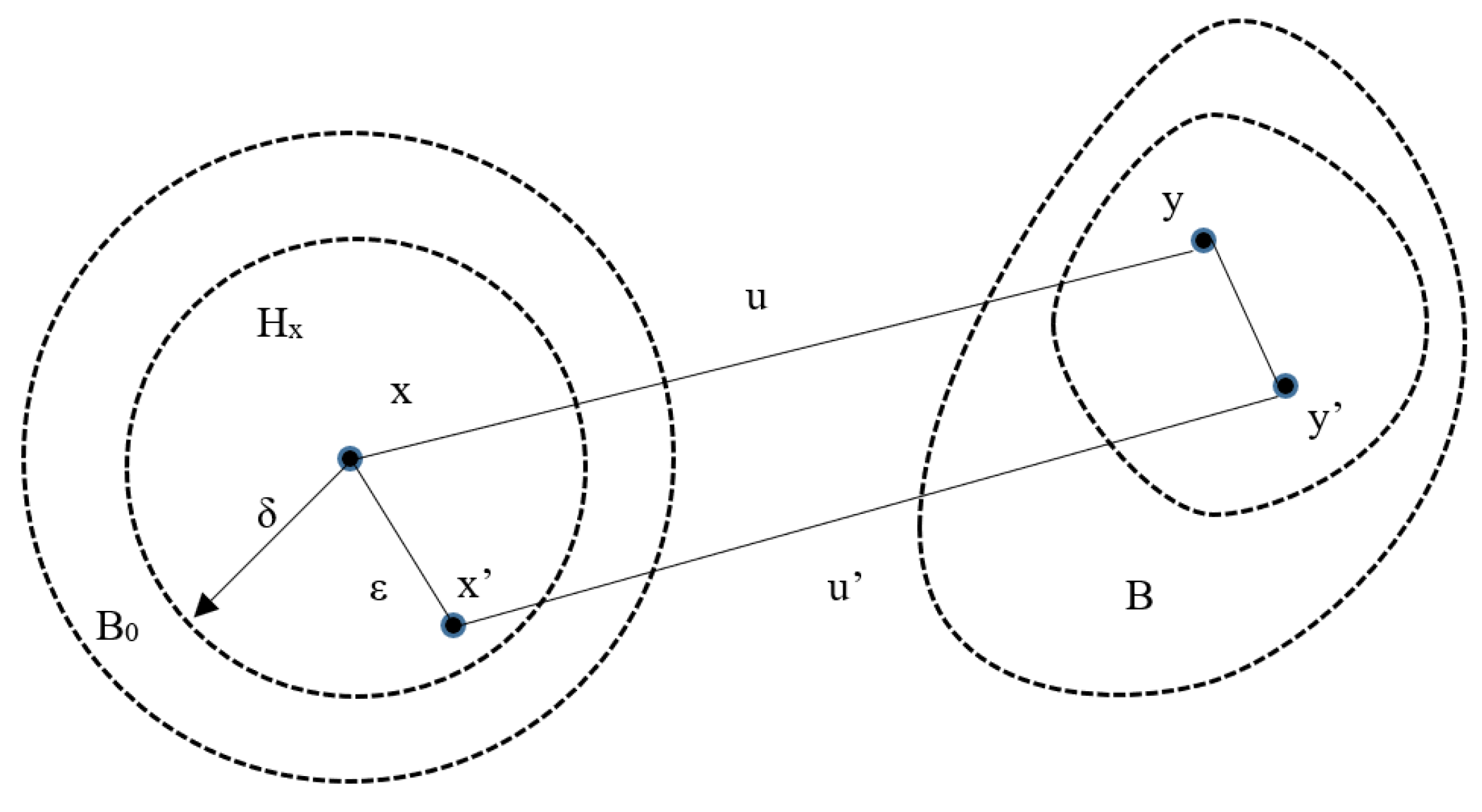
Figure two. (a) Lennard Jones potential and (b) Harmonic potential.
Figure 2. (a) Lennard Jones potential and (b) Harmonic potential.
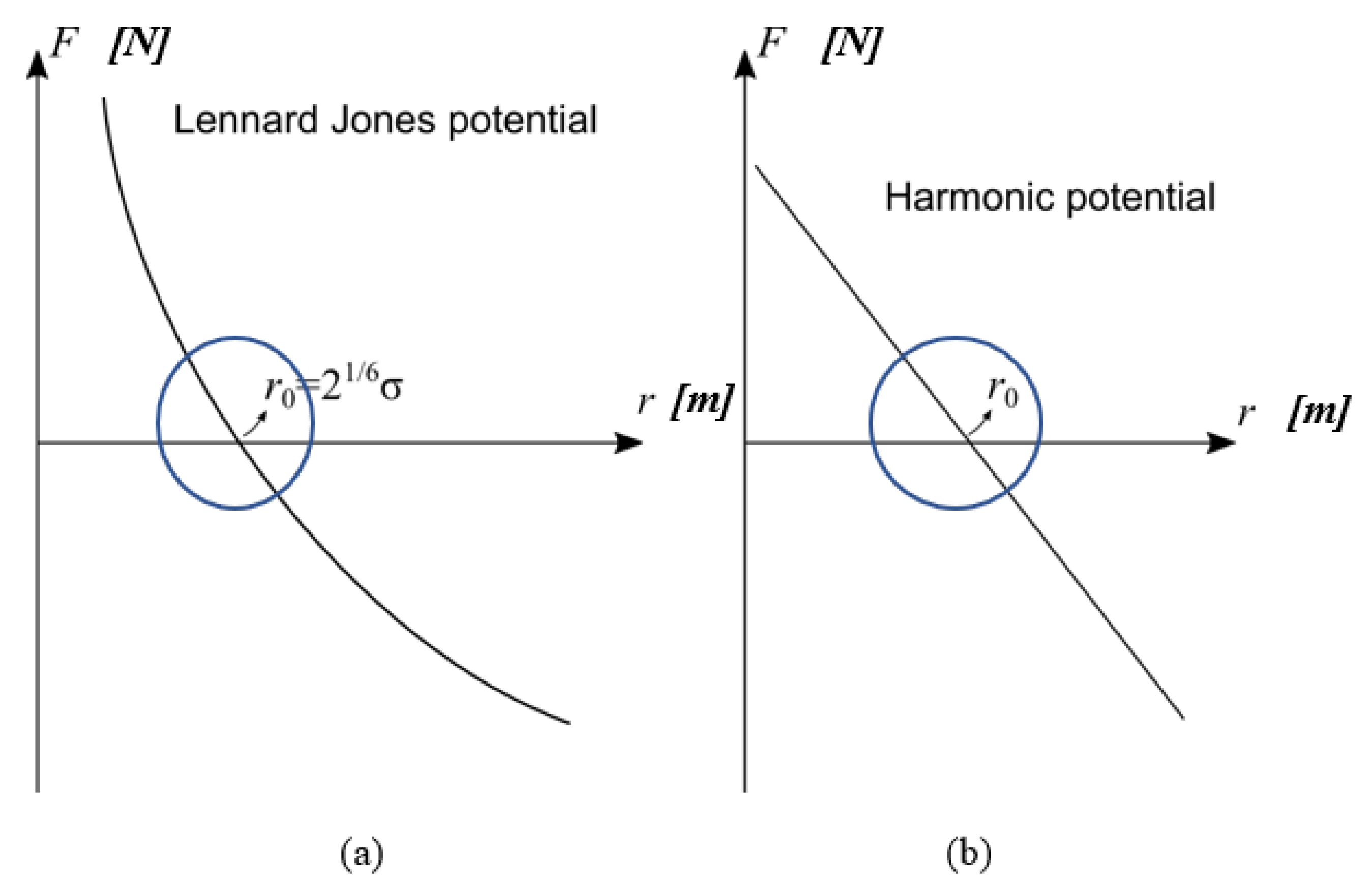
Figure 3. Asphalt (DA): blue particles represent the mortar; red particles represent the aggregate.
Figure 3. Asphalt (DA): blue particles represent the mortar; red particles stand for the amass.
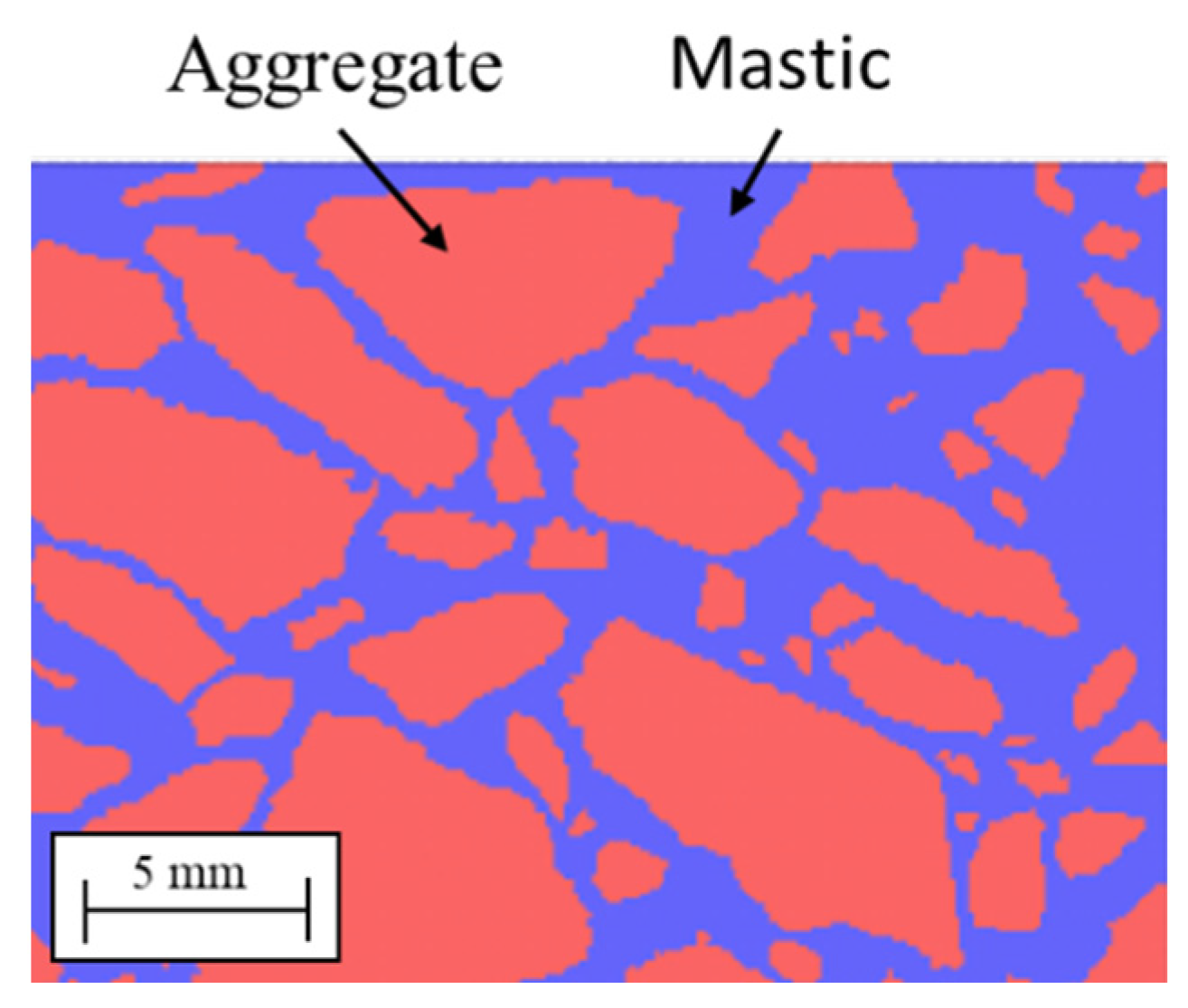
Figure 4. Samples (a) PA #1; (b) PA #ii; (c) PA #3. Blue particles correspond the mortar, red particles the aggregate.
Figure 4. Samples (a) PA #1; (b) PA #ii; (c) PA #three. Blue particles represent the mortar, ruby-red particles the aggregate.

Figure 5. Examples of PA #1 with a range of air void contents. (a) 0%; (b) 5 %; and (c) ten %.
Figure 5. Examples of PA #1 with a range of air void contents. (a) 0%; (b) v %; and (c) 10 %.

Figure 6. (a) PA #two/0.65% water ice; (b) PA #2/1.3% water ice; (c) PA #ii/3.25% water ice; (d) PA #ii/6.5% ice; (e) PA #2/9.75% ice; (f) PA #2/13% water ice Ice is represented by yellow particles.
Effigy 6. (a) PA #2/0.65% ice; (b) PA #2/1.three% water ice; (c) PA #2/iii.25% ice; (d) PA #ii/6.5% ice; (e) PA #ii/nine.75% ice; (f) PA #ii/13% ice Ice is represented by yellowish particles.
Effigy vii. Geometries of bitumen for tensile tests. (a) 3D, l = 10−3 thousand; (b) 3D, fifty = 5 × 10⁻⁴ m; (c) 3D, l = 2 × 10−iv chiliad; (d) example of a thin plate, l = 2 × 10⁻⁴ m.
Effigy 7. Geometries of bitumen for tensile tests. (a) 3D, 50 = 10−3 m; (b) 3D, 50 = 5 × ten−4 m; (c) 3D, l = 2 × 10⁻⁴ k; (d) case of a thin plate, l = 2 × x−4 m.

Effigy viii. Broken bitumen sample in the simulation.
Figure 8. Broken bitumen sample in the simulation.

Figure 9. Stress/strain of bitumen beams at different resolutions and loading rate and comparison with other experiments [45]. (a) In 3D and (b) as a sparse plate.
Effigy 9. Stress/strain of bitumen beams at dissimilar resolutions and loading rate and comparison with other experiments [45]. (a) In 3D and (b) equally a thin plate.
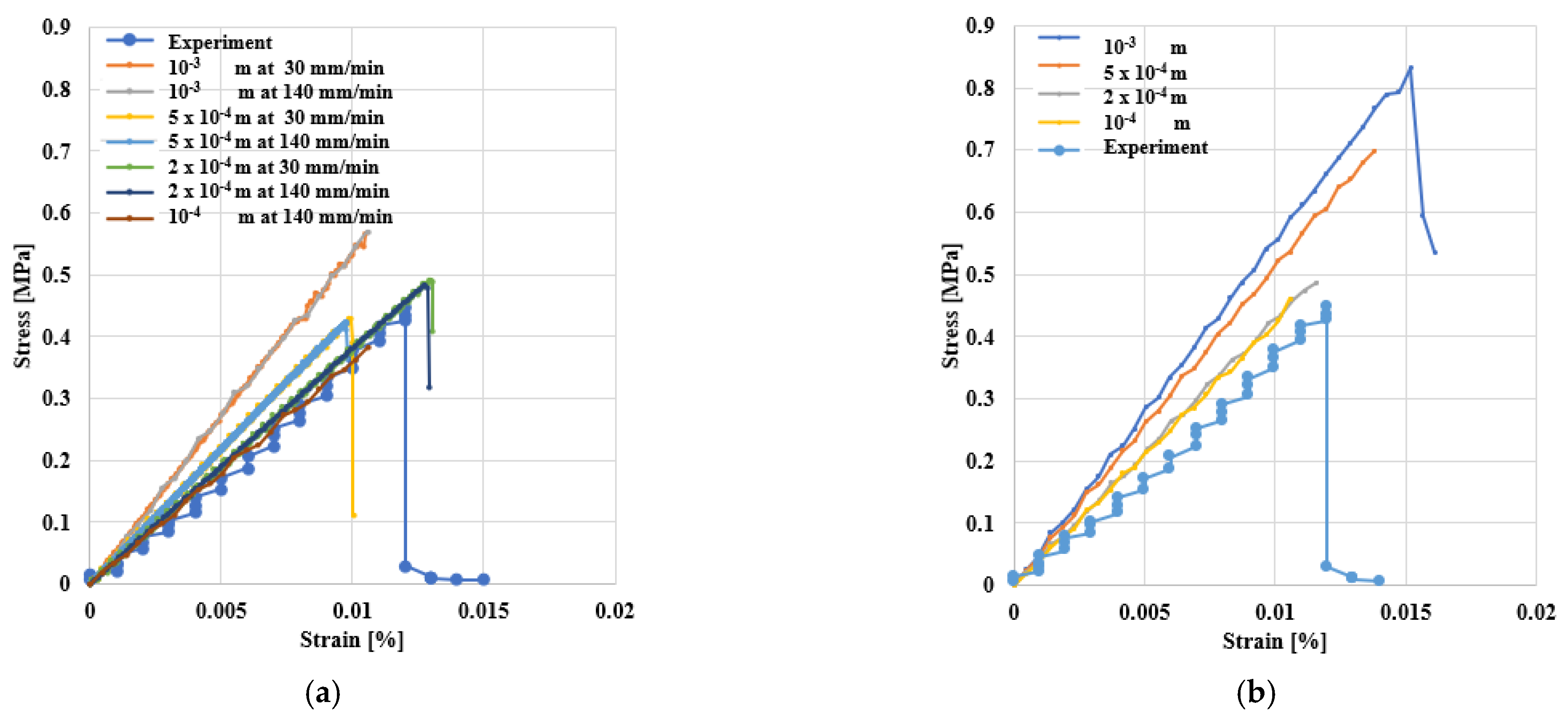
Figure 10. (a) Stress (blue curve) and the fraction of cleaved bond (damage, orangish curve) versus strain. (b) Micro-crack formation in an asphalt specimen.
Figure 10. (a) Stress (blueish curve) and the fraction of broken bond (damage, orangish bend) versus strain. (b) Micro-fissure formation in an asphalt specimen.

Figure 11. Stress/strain curves for PA #i (a), PA #2 (b) and PA #iii (c) samples.
Figure eleven. Stress/strain curves for PA #1 (a), PA #2 (b) and PA #3 (c) samples.
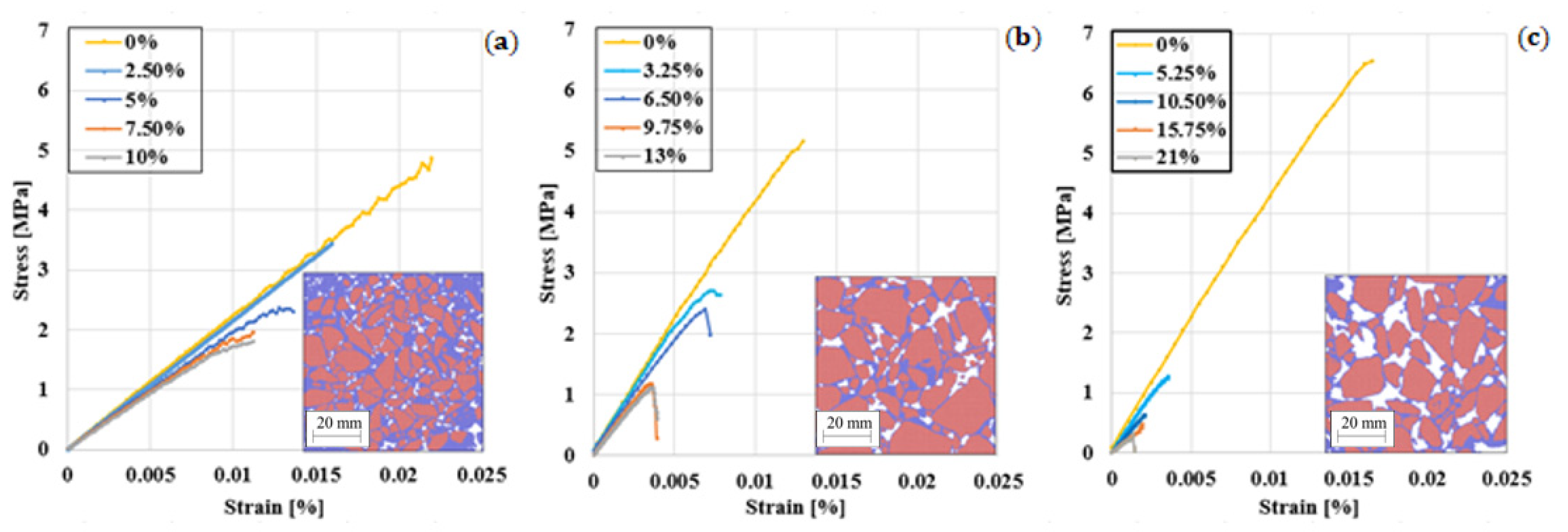
Figure 12. Changes of
with void %.
Figure 12. Changes of
with void %.

Figure 13. Cracking propagation due to ice expansion: (a) geometry; (b) harm.
Figure xiii. Cracking propagation due to ice expansion: (a) geometry; (b) damage.
Effigy fourteen. Reduction of peak stress with water ice %.
Figure 14. Reduction of top stress with ice %.
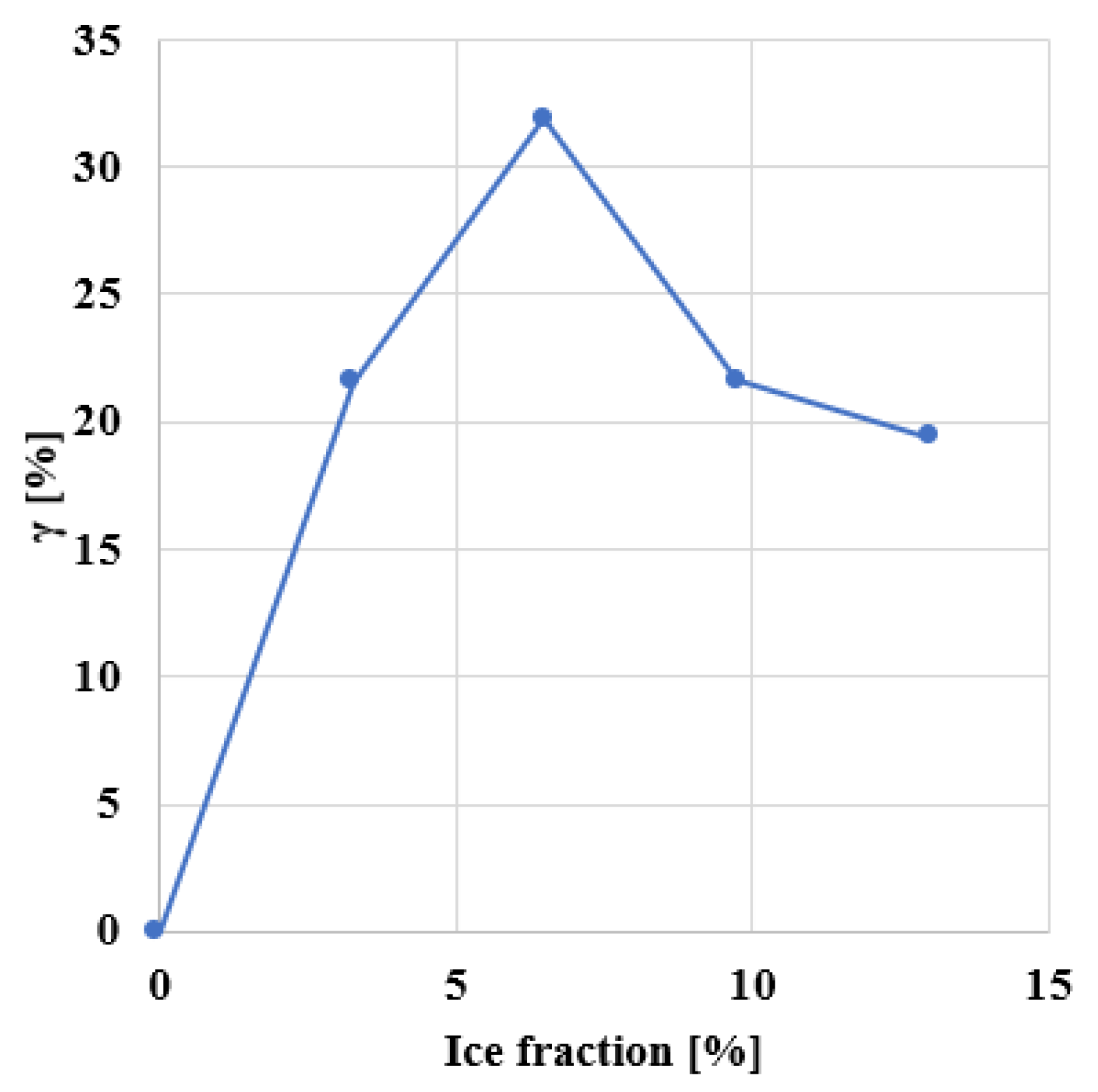
Table ane. Lennard Jones and Harmonic potentials and forces.
Table 1. Lennard Jones and Harmonic potentials and forces.
| Lennard Jones | Harmonic | |
|---|---|---|
| (15) | ||
| (16) |
Table 2. Asphalt mixture composition.
Table 2. Asphalt mixture composition.
| Size (mm) | Passing (%) DA | Passing (%) PA #1 | Passing (%) PA #2 | Passing (%) PA #3 |
|---|---|---|---|---|
| 20 | 0.9 | 0.0 | 20 | 10 |
| 14 | 15.viii | 0.0 | 25 | 38 |
| 10 | 21.three | 35.ane | 26 | 35 |
| six.3 | 14.2 | 19.3 | 7 | 0 |
| Dust | 47.8 | 45.6 | 22 | 17 |
| Bitumen | 4.7 | four.v | 4.2 | 3.3 |
| Air void content | 5.0 | 10.0 | 13 | 21 |
Table 3. Cobblestone mixture composition.
Table 3. Asphalt mixture composition.
| Passing (%) | ||||||||||||
|---|---|---|---|---|---|---|---|---|---|---|---|---|
| Size (mm) | PA#1 seven.5% | PA#1 5% | PA#1 2.v% | PA#1 0% | PA#2 9.75% | PA#2 6.5% | PA#ii 3.25% | PA#2 0% | PA#three xv.75% | PA#3 10.5% | PA#2 5.25% | PA#3 0% |
| 20 | 0.0 | 0.0 | 0.0 | 0.0 | 19.five | 19.0 | 18.5 | eighteen.1 | 9.8 | 9.2 | eight.ix | 8.six |
| 14 | 0.0 | 0.0 | 0.0 | 0.0 | 24.v | 23.8 | 23.2 | 22.7 | 36.3 | 35.0 | 33.five | 32.iii |
| 10 | 34.5 | 33.9 | 33.three | 32.5 | 25.iii | 24.vii | 24.1 | 23.5 | 33.4 | 32.2 | xxx.nine | 29.7 |
| half-dozen.3 | 18.9 | xviii.five | 18.ii | 18.0 | 6.8 | half-dozen.vii | 6.6 | 6.4 | 0.0 | 0.0 | 0.0 | 0.0 |
| Dust higher up 1.18 mm [46] | 30.0 | 29.4 | 28.8 | 28.4 | 8.8 | 8.vi | viii.4 | 8.3 | half-dozen.vii | 6.iv | six.ii | 6.0 |
| Grit beneath 1.18 mm [46] | 16.half-dozen | xviii.2 | 19.7 | 21.1 | fifteen.1 | 17.two | xix.ii | 21.0 | thirteen.eight | 17.2 | 20.v | 23.iv |
| Bitumen | v.2 | 5.nine | half-dozen.5 | 7.1 | 5.2 | vi.ii | 7.0 | 7.ix | v.1 | 6.8 | eight.2 | nine.5 |
| Air void content | vii.five | 5.0 | ii.5 | 0.0 | 9.75 | 6.5 | three.25 | 0 | 15.75 | x.v | 5.25 | 0 |
Table 4. Topological backdrop of the voids calculated from the CT-scans.
Table 4. Topological backdrop of the voids calculated from the CT-scans.
| Sample | Void Content [%] | Mean Void Bore [mm] | Mean Void Area [mm2] | Hateful Void Perimeter [mm] | Mean Void Aspect Ratio [—] | Mean Void Circularity [—] |
|---|---|---|---|---|---|---|
| PA #one/0% | 0.00 | 0.00 | 0.00 | 0.00 | 0.00 | 0.00 |
| PA #one/2.5% | 2.50 | ane.nineteen | 1.11 | ii.80 | 1.87 | 0.72 |
| PA #1/5% | 5.00 | 1.47 | i.70 | 3.63 | 1.99 | 0.67 |
| PA #1/7.5% | 7.50 | 1.67 | two.nineteen | iv.27 | 2.03 | 0.65 |
| PA #one/10% | 10.00 | 1.82 | 2.threescore | 4.82 | 2.03 | 0.64 |
| PA #2/0% | 0.00 | 0.00 | 0.00 | 0.00 | 0.00 | 0.00 |
| PA #2/3.25% | 3.25 | two.22 | 3.87 | seven.83 | 2.41 | 0.54 |
| PA #ii/6.v% | half-dozen.50 | three.29 | 8.50 | 10.05 | 2.41 | 0.51 |
| PA #two/9.75% | 9.75 | 3.82 | xi.46 | 11.60 | two.38 | 0.49 |
| PA #2/13% | 13.00 | 3.42 | ix.18 | 13.48 | 2.forty | 0.48 |
| PA #3/0% | 0.00 | 0.00 | 0.00 | 0.00 | 0.00 | 0.00 |
| PA #three/five.25% | 5.25 | 3.73 | 10.92 | 20.75 | 2.29 | 0.48 |
| PA #3/10.five% | x.fifty | 4.79 | xviii.01 | 23.80 | two.11 | 0.49 |
| PA 3/15.75% | xv.75 | 5.57 | 24.35 | 23.95 | 2.16 | 0.47 |
| PA #3/21% | 21.00 | 6.06 | 28.83 | nineteen.36 | two.eleven | 0.51 |
Table 5. Mechanical backdrop of bitumen, mastic and aggregates at −ten °C used in the simulations.
Table 5. Mechanical backdrop of bitumen, mastic and aggregates at −10 °C used in the simulations.
| Fabric | ρ [kg m3] | Due east [GPa] | ν [-] | G0 [kJ/m2] |
|---|---|---|---|---|
| Bitumen, PG64-22 at −xviii ℃ [45] | 1000 | iii.vii | 0.xxx | — |
| Mastic [48] | 2200 | 18.2 | 0.25 | 270.00 |
| Aggregates [48] | 2500 | 56.eight | 0.xv | 0.25 |
| Interface mastic/aggregates [48] | — | 18.2 | 0.25 | 77.00 |
Table 6. Peridynamic parameters used in the simulations. s00 is divers past Equation (nine).
Table 6. Peridynamic parameters used in the simulations. s00 is defined by Equation (9).
| Model | l [grand] | s 00 [—] | α [—] | N |
|---|---|---|---|---|
| Bitumen beams (3D) | one × x−3 | 1.2 × 10−iv | 0.xxx | 3366 |
| 5 × 10⁻⁴ | 1.2 × 10−four | 0.30 | 23,331 | |
| ii × x−four | 1.2 × 10−iv | 0.30 | 332,826 | |
| i × x−four | 1.2 × 10−iv | 0.30 | 2,580,651 | |
| Bitumen beams (Thin plate) | ane × x−3 | 2.0 × 10⁻⁴ | 0.30 | 3927 |
| 5 × ten−4 | 2.0 × x−iv | 0.30 | 14,847 | |
| 2 × 10−four | 2.0 × ten−4 | 0.thirty | 76,806 | |
| 1 × 10⁻⁴ | 2.0 × 10−iv | 0.30 | 303,606 | |
| Mastic, DA | ane × 10−iv | half dozen.4 × 10−3 | 0.25 | — |
| Amass, DA | one × 10−iv | 1.3 × ten−4 | 0.25 | — |
| Interface, DA | 1 × 10−four | 3.4 × x−3 | 0.25 | — |
| Mastic, PA | 4 × 10⁻⁴ | 3.2 × x−3 | 0.25 | — |
| Aggregate, PA | 4 × x−4 | 6.5 × 10−v | 0.25 | — |
| Interface, PA | iv × 10−four | 1.vii × 10−3 | 0.25 | — |
Table vii. Pearson correlations between the mechanical and the topological properties of the samples.
Table 7. Pearson correlations between the mechanical and the topological properties of the samples.
| Properties | Void Content | Hateful Void Diameter [mm] | Hateful Void Expanse | Mean Void Attribute Ratio | Mean Void Circularity |
|---|---|---|---|---|---|
| Ultimate strength | −0.62 | −0.64 | −0.58 | −0.52 | −0.37 |
| Ultimate strain | −0.77 | −0.92 | −0.82 | −0.73 | −0.41 |
| Equivalent Young modulus | −0.26 | 0.02 | 0.09 | −0.32 | −0.57 |
| Publisher's Annotation: MDPI stays neutral with regard to jurisdictional claims in published maps and institutional affiliations. |
© 2021 past the authors. Licensee MDPI, Basel, Switzerland. This article is an open admission article distributed nether the terms and weather condition of the Artistic Commons Attribution (CC BY) license (https://creativecommons.org/licenses/by/4.0/).
bunnyrecoughtell38.blogspot.com
Source: https://www.mdpi.com/1996-1944/14/7/1579/htm
0 Response to "Consider Again Perrins Data on the Number of Mastic Particles as a Function of Height"
Post a Comment