What Happens if You Blank a Tape Cassette and Reapply the Same Thing Again and Again Tape Over
Helena Watson Getty Images
Steve Stepp knew audiotapes were going to come back before you did, and not just because he'due south a man whose family unit company put its organized religion behind the machinery 50 years ago. Too because Pearl Jam called. Information technology was 2008 or 2009, and the xxth anniversary of the anthology X was coming upwards. They wanted to release a collector'southward edition that would include a CD, a cassette, a vinyl record, and a scrapbook.
"They were going to do 15 or xx thousand sets and run across how it would go over with their fans," says Stepp, president of the family unit-owned National Sound Visitor—i of the seven or and then remaining audio-cassette makers in the Us, and the only ane making the actual magnetic tape. "They came and contracted with us, and nosotros made the tapes and shipped them to their warehouse where they were all going to exist assembled." By the fourth dimension the tapes got there, the unabridged inventory had sold in presale.

Stepp secured a contract for a similar project with the Dandy Pumpkins (Ahem: "Bodies" is an underrated slice of music and I will fight anyone who says otherwise). Around the aforementioned time, major record labels began contacting NAC about releasing the music of young independent artists on tapes for cheap. So Disney called. Could Stepp's company create cassette soundtracks for the Guardians of the Milky way movies?
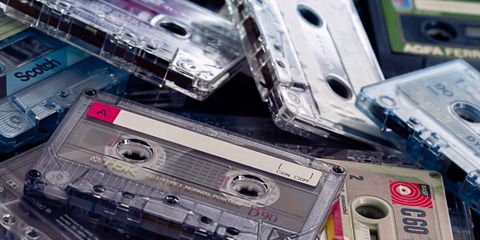
In 2017, according to an annual report from music-industry research company Buzzangle, cassette sales in the U.S. rose 136 percent, even more vinyl, which was the only other format in the beleaguered music industry that was still growing (digital was downwardly 23 percent). But while vinyl has been hailed as a high-fidelity format for serious audiophiles, cassette tapes are, well, hissy chocolate-brown spaghetti packed in a plastic card. They're the 1980s. Shoulder pads. They're goofy.
In fact, cassette tapes are remarkably similar to another historic cultural artifact that dates back much farther than the 1980s: Wooly Willy. In the game, yous moved a magnetic stylus around to attract and marshal thin metal filings around a drawing face. In cassettes, the tape deck passes an electrical current over a tape'due south thin metallic blanket, adjustment the needle-shaped particles into magnetic patterns that tin be read as audio. "Nil physically moves," says Stepp. "Yous're only changing the magnetic fields within the tape." To rerecord on the same slice of tape, you just scramble the oxide particles and realign them to a different song.
This process has its downsides. For one thing: Metal particles that oasis't been arranged into design with the song, extras that are simply sitting around, can create a surface dissonance called record hiss. The louder you tape on a tape, the less probable this effect is to happen. Also: Sure types of tape reproduce loftier frequencies poorly. And God help you lot if your record deck "eats" the ribbon.

To combat the sound-quality issues, if not unspooling mishaps, cassette makers adult a number of different varieties of magnetic record, differentiated by the magnetic fabric coating the polyester base moving picture—Type I, Blazon II, and, briefly, Type IV. ("I never did know most Type Iii," says Stepp. "Information technology died on the drawing board or something." He's basically correct.) Type I, the most common and least truthful to sound, was covered with ferric oxide, which made information technology ruddy or brown. Type 2, which was black, used chromium dioxide or cobalt ferric oxide to create a higher output, and therefore increased signal-to-noise ratio, chosen headroom. Type IV was more than experimental—a very high-functioning metallic tape that created fantastic sound but would grind fiddling grooves beyond the playback equipment later plenty utilize.
The tapes of the resurgence, at least for at present, are of the offset variety. National Sound Co.'s equipment, including a bunch of machines that had previously been producing strips for credit cards, brand Type I tape. But within the next couple of weeks, it will exist a new, improved 2018 version. "We took two years to create a process to mill the particles (used in reel-to-reel studio masters) downwards to a miniature size," he says. "The new record will be a Type I, but it will accept the operation and headroom of the Type II tapes. In fact, it'due south a little bit hotter."
Even if the new record isn't the hottest thing since the Prince anthology 1999 on cassette (which was hot), a little hissing has naught on analog nostalgia. A Spotify playlist might work for a party, simply you can't put 1 in a big smash box and play it directly through on the beach. And words on a screen just aren't as romantic as a handwritten set list in the back of a mixtape case. So besides: "Your ears are analog. The natural world is analog," says Stepp. "The reason people like cassette tapes and vinyl is that they reproduce actual, analog sound, with all the harmonics and frequencies your ears are built to heed to."

Despite his current practiced fortune, Stepp conspicuously remains a little beat out-shocked by the CD era. "Incidentally, the Recording Institute Association of America had an article a while back that said the CD had dropped 90 percent in retail music sales since its height in the year 2000. We have seen the coming and the going of the CD," he says at ane bespeak, as if he's however actively plotting revenge on the unabridged medium. Not that he'd have to lift a finger for his vengeance. He'south already getting it.
This content is created and maintained by a third party, and imported onto this folio to help users provide their electronic mail addresses. You may be able to detect more information about this and similar content at piano.io
bunnyrecoughtell38.blogspot.com
Source: https://www.popularmechanics.com/technology/audio/a24848370/cassette-tapes-national-audio-company/
0 Response to "What Happens if You Blank a Tape Cassette and Reapply the Same Thing Again and Again Tape Over"
Post a Comment